Dr. Matthew Spalding is the Kirby Professor in Constitutional Government at Hillsdale College and the Dean of the Van Andel Graduate School of Government at Hillsdale College’s Washington, D.C. Campus. As Vice President for Washington Operations, he also oversees the Allan P. Kirby Jr. Center for Constitutional Studies and Citizenship and the academic and educational programs of Hillsdale in the nation’s capital. He is the best-selling author of multiple books, which can be found here, and is the author of the newly-released The Making of the American Mind: The Story of Our Declaration of Independence. Hillsdale in D.C. sat down with Dr. Spalding to learn more about his latest book and what readers will gain from it.
- Why did you write this book? What is it about?
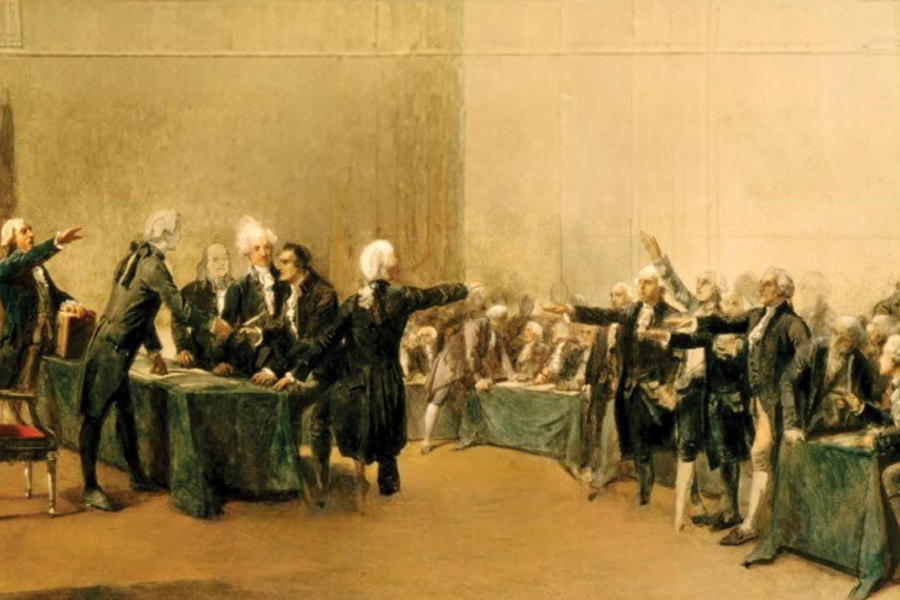
This book grows out of my own education and my teaching for decades and it focuses on the kind of centrality of the Declaration of Independence, an important document we oftentimes take for granted. I wanted to write a book that told the great story of how it came into being, how it was actually written, the debate in the Continental Congress, and the brave decision in the midst of war to make that declaration. But the other thing I wanted to do was actually to write a commentary—almost a line-by-line commentary of the words and phrases and their meanings—that would take us through the whole document, not just the famous parts, not just a few lines here and there but actually go through the whole document. So it would give us a sense of its general import as a political document created by the Continental Congress meant to make a regime argument at the moment they were declaring their independence and starting a new nation.
- What do you hope readers will learn from reading your book?
Hopefully a number of things at different levels! In general, I think that with the celebration of the 250th anniversary of the nation, this is a crucial moment for us to recover and to remember our own history. Whether we’re reviewing the narrative or hearing the story for the first time we need to learn it and recover it. At a deeper level, it’s important that we as citizens understand the meaning of the terms by which we are citizens, the principles of our own regime. And then I would say the third thing I hope people get out of it is this: Augustine wrote this a long time ago that you really can’t love something unless you know it. So part of my objective is to help us to know the Declaration of Independence in a deeper way, understanding its meaning, its purposes, but also the way it points towards eternal and transcendent truths about man and the natural order of things. Knowing all these things makes our country worth loving.
- Why is your book important today?
I would say it’s important today because of the 250th anniversary, but I would also point out is that we’re at a time in our own politics—our own history—when we’re debating virtually everything and we’re increasingly questioning everything. This is true on the Left and the Right. Our politics are quite confused as to what should be the basis of our politics. From a conservative point of view: what is it that we should be conserving? And what is truly liberating about the American tradition? One of the purposes of the book is to go back and relearn these things so as to reorient our current politics toward those fundamental truths, those first principles, and to give us some guidance today that I think we are currently lacking.
- After the commentary in the book on the Declaration, you have a closing chapter called “Iron Men.” What is that?
The phrase comes from a great speech by Abraham Lincoln in Chicago of 1858 when, almost in passing, he says of those who signed the Declaration, “They were iron men.” I think that’s a great line. I wanted to write an epilogue in the book about the signers, about all the people who signed the Declaration and what they did to support the Declaration with their lives and fortunes. Especially focusing on what they did in the Revolution. It pulls together a lot of original research that tells a very dynamic story about these great individuals, these “iron men.”
- Is there anything new you learned while writing the book?
There are always new things one learns in such a project, which is always wonderful. I would probably say I learned that the document which I’ve studied for decades and taught for decades is a much more powerful, and holistic document than I previously had thought: how it all fits together and makes an argument and how it rhetorically pulls its various parts together and is laid out, almost like a symphony with different rhythms and parts that work in harmony. There are a lot of historic details of different phrases and lines here and there, for instance; all their grievances that no one really knows about anymore. Just going through and learning about all those particulars and then putting them together I would say is probably the most fun thing but also the most interesting thing I learned in the process.
- When will your book be available for purchase?
The book is available for pre-order and it will officially be released mid-December. You can buy the book directly from Encounter Books, my publisher, or from Amazon. I will also be giving a talk on the book in our newly-renovated campus on January 22nd.
Pre-order The Making of the American Mind.
Read more about Dr. Spalding.
Sign up for Hillsdale in D.C.’s monthly e-newsletter to stay updated on events, programming, and news.