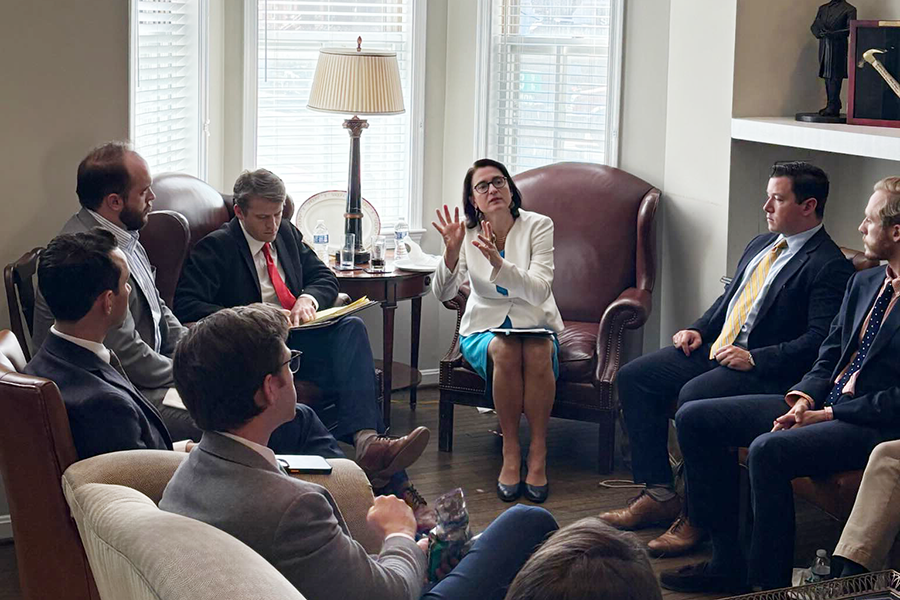
Graduate School of Government Hosts Austrian Member of Parliament, Discusses Immigration and Pro-Life Issues
The Van Andel Graduate School of Government hosted Austrian Member of the National Council, Dr. Gudrun Kugler, to speak to the graduate students, as well as the James Madison Fellows. Around twenty attended to hear Dr. Kugler discuss pressing issues in the European Union, such as immigration and demographic shifts, and pro-life issues, including abortion and euthanasia, and what Americans and Europeans can do to reverse some alarming trends.
Kugler opened by speaking of her messages for American conservatives at this moment in time:
First, Kugler said that Americans and Europeans share a common heritage and a common future and underlined the concept of one Western world. She expressed sorrow for the seemingly drift apart of the two continents. Europe felt like a pond full of life and fish of all colors, but with a thick ice cap on top which takes time to melt, for common sense to reassert itself. America is ahead on some levels in terms of having the intellectual, societal and political entrepreneurs to offer a rhetoric for that common sense.
Second, she continued, some American conservatives seem to be content to work only with the European “far-right” parties. This will not work out on the long run: these parties cannot rule alone in the European electoral system. They are generally not Christian-inspired parties, and they tend to turn away from the West and the rule of law. While JD Vance’s intentions at the Munich Conference are laudable, Kugler went on, it may have backfired, as he was perceived to ignore the apparent security threats. The real conservatives in the center-right parties are a crucial balance for alliances, both among European right parties and across the Atlantic. In the meantime, to build the alliances, she asks American conservative elites not to write off Europe, and to keep trying to connect to the center-right, even if it is frustrating. The concept of One Western World should motivate everyone not to give up on each other.
In the United States, the birth rate per woman is at 1.6, but it is in danger of dropping further, Kugler remarked. The trend has been going on since 2008 in the U.S. (which she attributes to smartphones as well as to the financial crisis, which includes a housing crisis). In Europe, the big drop below reproduction occurred in the 1970s, so the trend has had a lot longer to set in. The effect is attributable less to smaller families among those who have children than to simple childlessness which increased on average by about 7. Of all childless people, only 1/3 is voluntary; 2/3rds of childless people say they wanted to have children but circumstances did not allow it. In the Catholic countries of Southern Europe, the trend is ironically most pronounced. In the East, emigration to the West exacerbates the trend.
These trends are now global, not even confined to rich countries; rates of childbirth are falling in Latin America, the Middle East, and Africa as well.
How does a society without children look? Kugler asked. She mentioned Arsène Dumont, who spoke of a “self-harming narcissism” already at the end of the 19th century. Jonathan Sacks, former Chief Rabbi of Great Britain, also described the link between perception of having children, meaning of life and childlessness.
At the policy level, to respond, Kugler said, Paul Moreland has identified a trilemma: a country can have two of 3 options: 1) low birthrate, 2) low immigration, and 3) economic growth, but it cannot have all three. Japan has opted to sacrifice economic growth, Spain has opened the door to massive immigration in an effort to keep growing.
The birthrate decline has to be reversed, Kugler affirmed, but in the meantime we must work to mitigate the consequences of population contraction. The welfare state is already under strain in many parts of Europe, and rural infrastructure is fraying, trying to attract people to live in the villages. Addressing these problems requires thinking beyond the electoral cycle (as in Kugler's report which addresses a 50-year period). Adaptation and mitigation do require family policy, but also productivity increases, which she says is where AI could come in handy and working younger and longer would be necessary. Family policy itself cannot just mean spending but also a fostering of a public dialogue in which parenthood is positively depicted especially in culture and media, and teaching couples to understand fertility windows, and why it is good to have children at a younger age.
Learn more about the Van Andel Graduate School of Government.
Learn more about the James Madison Fellowship.
Sign up for our monthly e-newsletter to stay updated on Hillsdale in D.C.'s latest events and programming.